Showing posts with label green living. Show all posts

6.01.2013

Dyeing with marigolds and madder

After the workshop there was some leftover dye stuff that Dagmar let us take. I grabbed a bag of marigold heads and a jug of the madder extract dyebath with a little cochineal mixed in. I took advantage of the recent surge beautiful weather to dye some yarn. My original plan was to use only the marigolds and leave the madder for overdyeing some cotton that I don't like a little later. The dye that comes from the first extraction of the marigold heads is a rich, golden color. I love the color, but decided I wanted to go more orange with this batch so I ended up adding about half of the madder stock to the pot.

On the left is the marigold dye stock and on the right is the marigold with the added madder/cochineal stock.
I mordanted the original skeins in a 15% wog alum bath and let them sit overnight. After I finished, there was still a bit of dye left in the pot so I filled up the rest of the gallon jug that was storing the madder/cochineal dye with some of the leftover stock. I then mordanted another skein in a 15% alum bath and dyed with what was left in the jug giving me a redder orange.

On the left, the marigold with a bit of the madder/cochineal and on the right,  the madder/cochineal with a bit of marigold. 
This weekend, Chris and I are going to try and get some good greens out of red onions skins. Hopefully things will go as planned, I will post about that next week. 

6.28.2011

Day 28: Salt Scrub

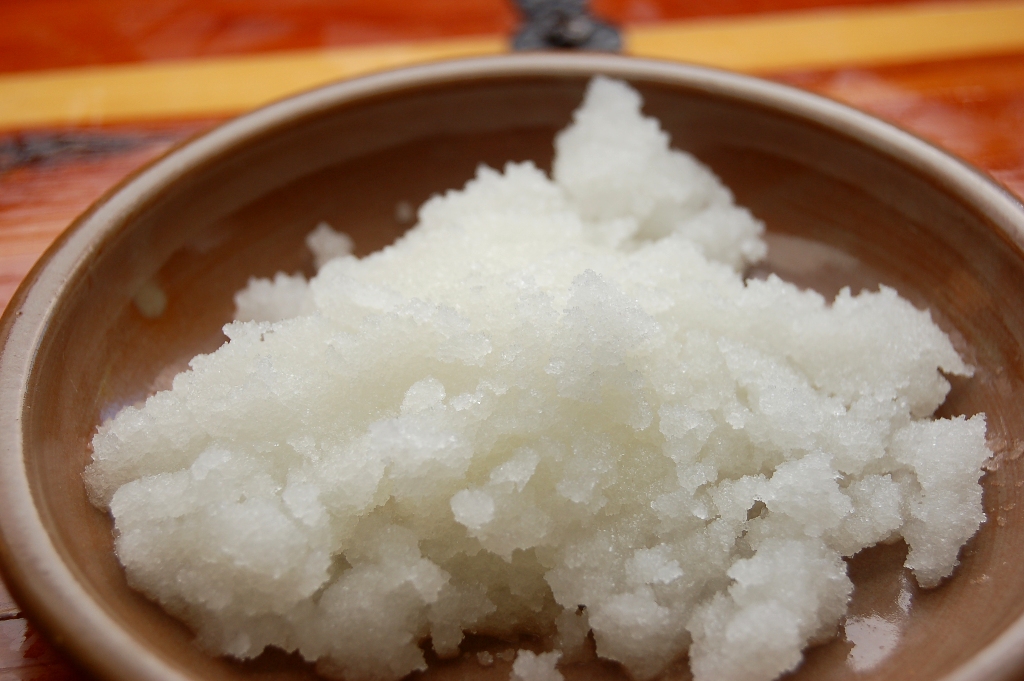
For the last several years mosquitoes have avoided me, but my body chemistry must have changed because this year I seem to be a mosquito buffet. To remedy this I decided to make a salt scrub that would double as a repellent for those little creatures who feel the need to bite me. This simple scrub is 3 parts sea salt, 1 part oil, and a bit of lemon eucalyptus and citronella essential oils. It doesn't smell great, but it smells way better than chemical bug spray and it will do the job.

6.16.2011

Day 16: Stabby

Today I made dryer balls using this very simple tutorial. I had some plastic dryer balls that disappeared a few years ago so instead of replacing them with more petroleum-based products I decided to use the natural materials I had on hand to make new ones. I just bought a retractable clothesline for my backyard which means I will be line drying for the summer so I won't try these out until the cooler months, but six balls in the dryer are supposed to cut 30% off drying time and eliminate static.

6.13.2011

Day 13: Crochet

For the past few years I have been in the process of phasing out several of my personal care products in favor of things that are more environmentally-friendly and local. One of the more difficult changes for me is eliminating the products that are diluted with water in favor of denser, drier products. I did the no poo thing for awhile with baking soda and it was okay, but I really craved the lather of a shampoo and I missed the lovely way my hair smells after a wash. I decided that a natural shampoo bar would be a good compromise since it still uses less packaging and has less water than traditional shampoos. Switching to a shampoo bar has been an off-and-on two year trial, apparently my hair is really picky about what I use to clean it. Recently I stumbled upon a winner, but it is not cheap stuff so I decided to make a little soap saver to keep it in. This is just a simple crocheted pouch with a drawstring that I made with some leftover Euroflax. The purpose of the pouch is to get more suds out of a single bar and to help it dry faster which will make it last longer.

6.09.2011

Day 9- Face Cleanser

For the past few weeks I have been experimenting with oil ratios to use with the oil cleansing method. After several trials, I have put together an oil blend that works well with my skin and today I finally mixed up and bottled the blend. I really like the oil cleansing method because it is all natural and the application is a complete joy, a great end to a busy day. You can read more about the oil cleansing method here.

10.18.2009

Hoot Water Bottle Cozy

I came up with this cozy idea a few weeks ago when the cold weather really started to set in. I love the idea of portable heat sources that use little energy and allow me to roam freely around my cold house (I generally keep the thermostat at 60 degrees all winter.) The owl cable came from an old Leisure Arts vest pattern I was given a few years ago. This cozy will dress up any standard 2 liter hot water bottle and it will keep it warmer longer.

Hoot Water Bottle Cozy
Gauge: 14 stitches/ 18 rows = 4" in Stockinette stitch with two strands held together
Finished Measurements: 7.5" wide x 14" tall (will fit a standard 2 liter hot water bottle)
Materials:
Needles: Set of US10.5 dpns or size needed to obtain gauge and crochet hook size J
Yarn: 1 ball Cascade Ecological Wool in color 8061 (project uses approximately 140g.) or two hanks of Blue Sky Organic cotton, about 2 yds of darker colored natural fiber yarn for the eyes.
Notions: tapestry needle for weaving in the ends and embroidering the eyes.
Pattern Notes:
Project is worked using 2 strands of yarn held together throughout.
Definitions:
c4f: Sl 2 sts to cable needle and hold in front, k2, k2 from cable needle.
c4b: Sl 2 sts to cable needle and hold in back, k2, k2 from cable needle.

Pattern:
Using the figure 8 cast-on method*, Co 52 stitches on two dpns (26 stitches on each needle).
Rnd 1: Knit first rnd onto two needles and redistribute onto 4 needles at end of rnd. Place marker to mark the beginning of the rnd.
Rnd 2-16: knit
Rnd 17-18: *p4, (k8, p3) x2, rep from * to end
Rnd 19: *p4, (c4b, c4f, p3) x2, rep from * to end
Rnd 20-26: *p4, (k8, p3) x2, rep from * to end
Rnd 27: *p4, (c4b, c4f, p3) x2, rep from * to end
Rnd 28: *p4, (k8, p3) x2, rep from * to end
Rnd 29-30: *p4, (k1, p2, k2, p2, k1, p3) x2, rep from * to end
Rnd 31-32: *p4, (k8, p3) x2, rep from * to end
Rnd 33: *p4, (c4b, c4f, p3) x2, rep from * to end
Rnd 34: *p4, (k8, p3) x2, rep from * to end
Rnds 35-45: knit

Decreases
Rnd 46: *k1, ssk, k21, k2tog, rep from * to end
Rnds 47 and all odd rnds through 55: knit
Rnd 48: *k1, ssk, k19, k2tog, rep from * to end
Rnd 50: *k1, ssk, k17, k2tog, rep from * to end
Rnd 52: *k1, ssk, k15, k2tog, rep from * to end
Rnd 54: *k1, ssk, k13, k2tog, rep from * to end

Neck
Rnd 56: *(k2tog) twice, yo, rep from * to end
Rnd 57-70: work in k1, p1 ribbing
Bind off loosely and weave in ends.

Tie
Using the crochet hook, create a 21" crochet chain and weave it through the eyelets at the base of the neck.

Eyes
With the darker yarn and the tapestry needle, embroider over the purl stitches that make up each owl's eyes using the satin stitch.

*While the figure 8 cast-on is ideal for this project, if you feel uncomfortable using it you can CO 52 stitches onto 4 dpns and join for knitting in the round. Then, at the end of your
project you can simply seam the bottom of your cozy.

To use- Slide water bottle into cozy, secure with tie, and fill with hot water.

4.29.2009

Worms!!!

After years of talking about it, I finally set up a vermicompost bin in my house. I love worms and the idea of living with a few thousand of them in my basement makes me so giddy I can hardly stand it. Anyway, here are the pics of my wormy adventures today. Thanks to Raellyn for sharing her worms with me and helping me set up my bin.

Here is a closeup of my worms. They need some time to settle into their bedding so right now they are all huddled together in the middle of the bin under the paper. Having this many worms in one place totally freaked Philip out, it was kinda funny.

This is what the bin looks like in its finished state. I made the bedding out of shredded phone book pages, rings from toilet paper tubes, and some soil.

Tomorrow I get to start adding my food scraps to the pile which will really get things going. I am keeping the bin in the basement since it stays cool and dark year-round.

10.23.2008

Time to heat the apartment

I can't believe how quickly the weather went from pleasant to cold. We have been avoiding using our heat and yesterday was the first day that we really felt cold. When we got into bed we were both shivering like crazy. We ended up snuggling together under all of the blankets to warm up. We talked about turning the heat on, but neither of us wanted to give up the warmth of the bed for the minute it would take to light the furnace. In a way it was kinda nice, it was really cold but we were victorious in making it another night without turning on the heat. Tonight we have a friend passing through and crashing at our place, my guess is that she will want the heat, especially since she will be sleeping in the coldest room of the house. This got me thinking of ways to save on heat in our new place. We still aren't sure what our winter gas bills are going to look like, but we are going to do whatever it takes to keep them low.

Tomorrow I will be winterizing the house which is the first step to saving on heat. This simply means putting in or pulling down all of the storm windows, removing the window unit in our bedroom, and weather striping any leaky windows and doors. These are just basic things, but doing them all last winter (as opposed to the two prior winters that we didn't) ended up saving us a few hundred dollars on heat (it is amazing how much heat you lose through a few drafty windows.) Our new place is a little newer and seems to have better windows so there probably won't be a lot to do there.

Next, we keep our thermostat set pretty low, as cold as we can stand, and we just wear warm clothes around the apartment. If you can stand it, turn the heat off during the warmest hours of the day or when no one is home (though keep your pipes in mind when doing this.) This is where knitting comes in handy. Both Philip and I have those Fiber Trends clogs which are very warm (and they are super fun on hardwood floors.) Both pairs were made by my friend Sarah out of recycled wool which is an excellent option for the vegans out there who don't want to support the wool industry. We also wear hats and gauntlets around the house along with extra layers of clothing for added insulation.

Another great way to save on heat is use all of the free heat that you can get. This means opening up your drapes and blinds and letting in the sunshine during the day. This is really one of the hardest things for us, we seem to turn into cave dwellers during the winter and tend to keep things a little on the dark side. We managed to do this about 50% of the time last winter and it did make things warmer and there was the added bonus of the extra light making things a little cheerier.

My final tip is to eat at home. Turning that oven on and preparing a nice warm winter meal will save you money on eating out and your oven will keep you nice and toasty while you are cooking. Alternately, you could bake a loaf of bread, or a pie, or a frozen pizza if you aren't the cooking type and you will get the same benefits. I should clarify here that I am not recommending that anyone use their oven as a heater, that is both inefficient and dangerous, I am just saying that cooking will add five to ten degrees to the temperature of your kitchen so if you are hungry and cold opting out of fast food and microwave meals and using your oven instead will help warm things up.

4.20.2008

Another pair of shoelaces

Philip found these old Nikes that fit him perfectly and he really wanted some yellow shoelaces to go with them. I am trying to keep our house as sweatshop-free as possible and I thought about the yellow sock yarn sitting in my stash from the Anticraft heart which was the perfect size for some shoelaces. I casted on 3 stitches and worked 32" of i-cord. They are finished with tape and glue so they will stay together as well as a store-bought pair. I like these much better than the first pair that I made on a knitting spool though these don't sparkle.


I really like making things I need out of materials I already have. While I was working on these shoelaces, several people commented on how it was a waste of time. To that I explained that by the time I factor in the time spent searching for the perfect yellow shoelaces and the gas used to drive around searching for said shoelaces it would probably be faster and cheaper to make them myself. Plus, I don't get the same kind of satisfaction from buying as I get from making things myself. The other day I ran across the Story of Stuff which reaffirmed my desire not to become one of those Americans who use shopping as a way to feel better about themselves. Everyone should watch this video and more importantly learn from it and use at least some of the tips given after the video.

9.21.2007

Car vs. Bike

Philip and I decided five years ago when we moved in together that we would be a one car family. This was really easy to do in Norfolk since we worked together and lived within walking distance of almost everything we needed. When we decided to move to Lexington, the single car thing became a little more difficult. We weren't sure where we would be working so we looked for a place downtown so if necessary, we have quick and easy access to public transit. I ended up keeping my job and working remotely from home which made thing pretty easy for the first few months, but when the shop opened my need for transportation resurface. For the first year of the shop's existence I walked back and forth to the shop and many days Philip would pick me up in the evenings (which used as much gas as if I was driving.)

I recently started riding my bike again (after finally replacing my tires) and it has been an incredable experience. I love riding my bike to the shop; I get there faster and I feel more energetic throughout the day since I got my heart rate up early in the morning. I try to go on a bike ride every morning, even if I don't have any errands to run, it just makes my day feel more pleasant. No Impact Man was on Good Morning America today talking about the advantages of bike riding so for today's green living tip I am going to refer you to his post all about biking for transportation.

8.31.2007

Let's talk about food

It's Friday again so I am throwing out another green living tip.

This week: Buy Locally

Our food choices have more effect on this planet than anything else we do so by supporting small sustainable farmers and buying food that doesn't travel thousands of miles to your plate you are greatly reducing your ecological footprint. There are two really simple ways to do this which won't cost you a fortune. First, check out your local farmer's market. The produce is ofter cheaper than the grocery store and definately fresher, plus you can talk to the people who grow your food. The farmers at the market know first hand how the food was grown and can give you tips and tricks for preparing it. Another great way to support your local farmers is to find a farm you like and buy a CSA share. CSA stands for community supported agriculture and essentially you are buying a share of a farm for a year which supports the farmers. You will get a weekly or bi-weekly box of produce throughout the summer and into the fall. If the farm does well, you will receive plentiful boxes of produce, but if they do poorly you will get smaller, less diverse baskets. No matter what, you make your community stronger by supporting a struggling small farmer.

Great resources:
100 mile diet- Great site about Eating locally
Local Harvest- Directory of CSA's throughout the country

8.24.2007

Earthday Fridays

In an attempt to blog more, I am designating every Friday as Earthday at Sweet Little Domestic Life. Every Friday I am going focus on a green product or activity that will make the world a cleaner place.

This week: Greening my Mail

I was cleaning my house the other day which involves making piles of papers to shred and papers to recycle. Over 90% of these papers were bills, bank statements or junk mail. I pay many of my bills online or by phone, but on most of my accounts I never bothered to set up online bill pay. The problem is that every company handles their bill paying differently and so set-up can be a bit of a pain. There are centralized billing systems like My Check Free, but they don't do billing from every company. You can also pay bills online through your bank, but you will still get the physical bills in the mail which means just as much waste. It took me about an hour to set-up an online account with all of my companies and to cancel my physical billing statements. I also set up an online account with my bank and canceled the statements that come to my house which, considering my latest encounter with bank fraud, is something that I should have done a long time ago. Now the only bill that will come to my house is the water bill (because the water company has no option for paperless billing, yet.)

After stopping all of the bill mail I felt really liberated so I decided to move on to the junk mail. It ends up that stopping the bills is much easier than stopping the junk. The average American receives almost 600 pieces of junk mail every year; can you imagine what that looks like in a landfill? There are about a million types of junk mail and each has to be controlled in a different way. Since I don't want to devote all of my free time to stopping the junk I just took a few basic steps which should stop the majority of my unwanted mail. First, I removed my name from the DMA and Direct Mail lists. Then, since most of my unwanted mail is credit card offers, I called the opt out number (800-567-8688) which is used by the three major credit bureaus. All of these services remove your name for five years so it is definately worth the few minutes it takes to do it. Alternately, if you are lazy and have money to burn, you can pay $41 to have these people remove you from dozens of lists (and 1/3 of the fee goes to non-profits so they aren't totally evil capitalists.)